Matrix OS vs Salesforce Agentforce: agent layer or owned workspace?
Compare Matrix OS and Salesforce Agentforce across CRM data, business actions, governance, agent orchestration, persistent compute, ownership, and enterprise fit.
Salesforce Agentforce is the stronger choice when agents should operate on Salesforce data, metadata, flows, and business actions within an enterprise CRM platform. Matrix OS is the stronger fit when an agent needs an owned, persistent computer with files, terminals, applications, and tools beyond the Salesforce environment.
These products have very different maturity, scope, and buying motions. Matrix should not be presented as a replacement for the Salesforce platform.
These comparisons use consistent criteria, cite current sources, and explain when the alternative is better. Enterprise teams should run security and architecture reviews.
At a glance
| Criterion | Salesforce Agentforce | Matrix OS |
|---|---|---|
| Center of gravity | Salesforce data, metadata, applications, and actions | Persistent cloud computer and agent workspace |
| Agent grounding | Data 360 and connected structured or unstructured data | Selected workspace files, repos, apps, and integrations |
| Actions | Salesforce flows, APIs, Apex, prompt templates, platform actions | Linux tools, terminal agents, and documented Matrix integrations |
| Governance | Salesforce enterprise security, observability, and administration | Owner-controlled workspace boundaries; validate enterprise requirements directly |
| Best fit | Enterprise customer workflows centered on Salesforce | Open-ended work requiring a general execution environment |
Where Agentforce is stronger
Salesforce positions Agentforce as a platform for designing and orchestrating agents using enterprise data, business logic, and actions. Its documentation describes actions backed by flows, prompt templates, Apex, and other platform capabilities. See how Agentforce works and the developer action model.
Organizations already standardized on Salesforce gain proximity to customer records, permissions, reporting, and existing automation.
Choose Agentforce when the workflow is fundamentally a Salesforce workflow.
Where Matrix is different
Matrix gives each agent or user a durable computer. The workspace can host code repositories, local documents, command-line tools, previews, applications, and different agent runtimes.
That creates flexibility for work that spans engineering and business artifacts. It does not provide Salesforce's CRM data model, Data 360, ecosystem, governance maturity, or prebuilt enterprise actions.
Platform data versus selected context
Agentforce can ground work in the Salesforce platform and connected data. Matrix can work from selected files and connected tools without requiring the company to centralize its operation in one CRM.
The first model can provide richer standardized business context. The second can reduce coupling and give the agent a broader execution environment. Each creates different permission, consistency, and maintenance responsibilities.
Which should you choose?
Choose Salesforce Agentforce if:
- Salesforce is a core system of record,
- agents need governed access to CRM data and platform actions,
- enterprise administration and observability are mandatory,
- the organization already has Salesforce architecture and operations capacity.
Choose Matrix OS if:
- the agent needs a general Linux computer,
- work spans repositories, documents, local tools, and multiple systems,
- you want a contained experimental environment,
- Salesforce-centered architecture would be disproportionate to the workflow.
Use both if Agentforce governs Salesforce-native customer actions while Matrix performs bounded work outside the CRM. Define which system owns each record and never let two agents silently update the same state.
Run a controlled pilot
Test one workflow with real exceptions: conflicting customer data, a missing approval, an unavailable connector, and an action that must be reversed. Measure completion, source traceability, administrative effort, security review, reviewer load, and total operating cost.
The winning product is the one whose control model matches the system where the decision belongs.
Explore Matrix's enterprise AI lab or read about permissions and audit.
Try a first task in Matrix
Prototype a fictional account brief without changing Salesforce records.
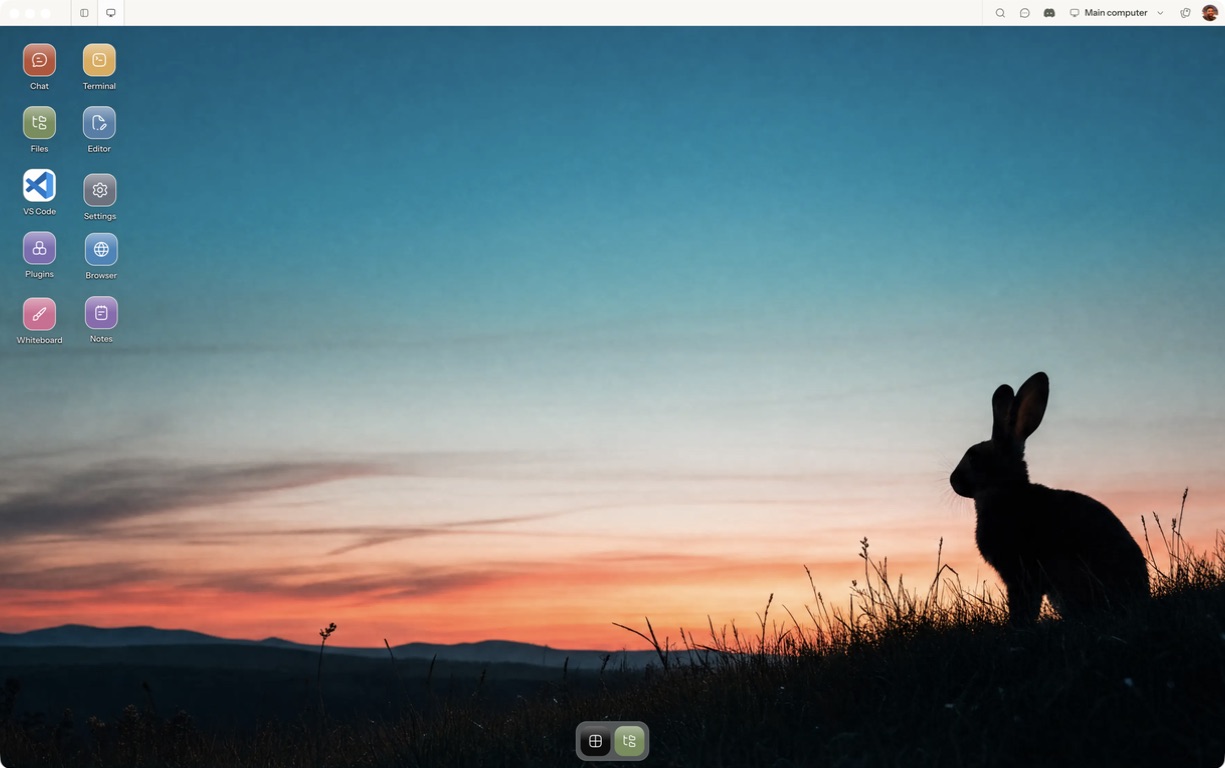
- Follow the quickstart to sign in, choose a computer and complete any required provisioning. To use the native app, follow the desktop installation and approval steps.
- Open a separate session with a small sample project or synthetic input. Configure the agent access needed for that task and make the expected output explicit.
- Confirm record ownership, permission boundaries and the actions a pilot would need.
For a worked coding example, use the setup and reconnect walkthrough. Inspect the result before expanding the scope or leaving a longer task unattended.
Open Matrix →Read the quickstart →Current plans and pricing →