Matrix OS vs Claude Projects: context window or persistent workspace?
Compare Matrix OS and Claude Projects across shared knowledge, project instructions, conversation context, tool execution, persistence, and team workflows.
Claude Projects is the better choice when you want Claude conversations to share project instructions and an uploaded knowledge base. Matrix OS is the better fit when the project needs a persistent computer with files, terminals, running processes, and a choice of agent tools—including Claude Code.
The decision is between a model-centered context workspace and an environment-centered operating workspace.
These comparisons are neutral and based on current official documentation. Verify plan limits and capabilities before purchase.
At a glance
| Criterion | Claude Projects | Matrix OS |
|---|---|---|
| Core experience | Claude chats with shared project knowledge | Persistent cloud computer for people and agents |
| Context | Uploaded project knowledge and instructions | Files, repos, sessions, transcripts, apps, and workspace records |
| Model | Claude | Bring Claude Code, Codex, OpenCode, Gemini CLI, and others |
| Execution | Claude capabilities available in the product | General Linux processes, terminals, previews, and tools |
| Collaboration | Private or organization-visible projects on supported work plans | Workspace and session sharing patterns; validate team requirements directly |
| Best fit | Knowledge-intensive Claude conversations | Work requiring durable execution and environment control |
Where Claude Projects is stronger
Claude Projects organizes conversations around a shared knowledge base and project instructions. Anthropic documents private and organization-visible options for work plans, with retrieval used as project knowledge grows. See Anthropic's Projects guide.
That makes Projects a natural fit for analysis, writing, research, and recurring conversations where Claude is the chosen model and uploaded knowledge provides enough context.
Where Matrix OS is different
Matrix gives the agent an actual computer. A Claude Code session can operate against a repository, run tests, start a preview, write files, and remain available when the user's laptop closes. The same computer can also host other terminal agents and tools.
Matrix's cloud-coding guide documents how projects, worktrees, sessions, transcripts, and previews remain in the user's Matrix home.
Compare the boundaries
Knowledge
Claude Projects makes selected knowledge immediately useful inside Claude chats. Matrix stores inspectable files and application state in a general workspace. Neither approach removes the need to decide which sources are authoritative and current.
Execution
If the work is primarily reasoning over documents, Claude Projects is simpler. If the job requires shells, packages, background processes, or several development tools, Matrix offers the broader execution layer.
Model commitment
Claude Projects is optimized around Claude. Matrix is model- and agent-agnostic at the computer layer, although each third-party agent retains its own account, pricing, behavior, and terms.
Sharing and governance
Anthropic provides documented project visibility within Claude for Work. Matrix buyers should validate current sharing, identity, audit, and administration requirements during a team pilot rather than infer enterprise parity from the workspace concept.
Which should you choose?
Choose Claude Projects if:
- Claude is the desired working surface,
- uploaded knowledge and shared instructions are sufficient,
- the outputs are mainly analysis and documents,
- you want less environment management.
Choose Matrix OS if:
- Claude Code or another terminal agent needs a persistent machine,
- the project contains running software and local tools,
- several agents should operate in the same environment,
- inspectable files and processes matter more than a curated chat context.
Some teams can use Claude Projects for knowledge work and Matrix for execution. Test how context moves between them before adopting both.
Run the same project for a week
Give each product a recurring task that uses source documents, requires an updated artifact, and includes one executable step. Return from another device and hand the project to a teammate. Compare context quality, traceability, execution, effort, and policy fit.
Run Claude Code in a Matrix cloud workspace or explore the professional assistant solution.
Try a first task in Matrix
Try one source-based brief and one repository task to identify your actual needs.
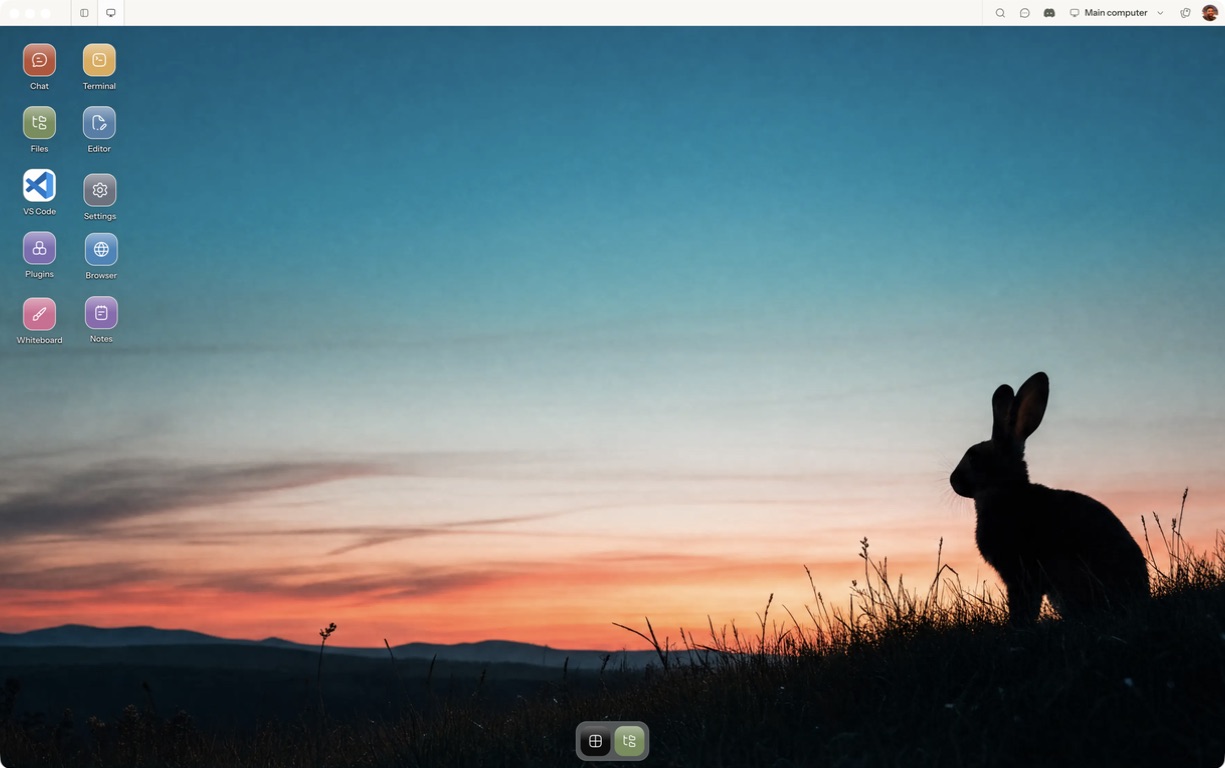
- Follow the quickstart to sign in, choose a computer and complete any required provisioning. To use the native app, follow the desktop installation and approval steps.
- Open a separate session with a small sample project or synthetic input. Configure the agent access needed for that task and make the expected output explicit.
- Separate project context from the computer, terminal and execution lifecycle.
For a worked coding example, use the setup and reconnect walkthrough. Inspect the result before expanding the scope or leaving a longer task unattended.
Open Matrix →Read the quickstart →Current plans and pricing →