The university AI lab in a box
A practical model for repeatable university AI labs with cloud computers, starter repositories, coding agents, persistent previews, and faculty oversight.
A university AI lab in a box is a repeatable cloud environment for courses, workshops, hackathons, and research groups. Each participant gets a consistent computer with the required files, tools, agents, and project context, while faculty define the exercise and retain oversight.
The goal is not to make every course identical. It is to remove accidental differences in operating systems, laptop power, permissions, and local setup so class time can focus on the work.
What should the lab include?
A practical lab template should define:
- operating-system and runtime requirements,
- starter repositories and datasets,
- approved coding agents and model access,
- package and tool versions,
- storage and compute limits,
- network and integration boundaries,
- assignment instructions and evaluation artifacts,
- retention and teardown policy.
The environment should be reproducible without making student work disposable. A learner needs continuity across sessions; an instructor needs a clean baseline for the next cohort.
One environment, several teaching modes
Courses
Provision a standard workspace for a semester, attach starter projects, and preserve files and previews between classes.
Workshops and hackathons
Prepare environments before the event so participants can begin from a browser rather than spend the opening hour installing dependencies.
Research groups
Give each researcher or project an isolated working environment with explicit data and compute boundaries.
Faculty experimentation
Run governed pilots away from primary university devices before adopting a new agent or skill more broadly.
Make agent use observable
Teaching with agents requires more than allowing or banning a chatbot. A lab can ask students to retain:
- prompts or task instructions,
- agent session output,
- changed files and diffs,
- test results,
- source citations,
- a reflection on what the student verified or corrected.
The artifact becomes evidence of process. Assessment can focus on reasoning, verification, and ownership rather than guessing whether AI was involved.
Build the lab around clear roles
| Role | Responsibility |
|---|---|
| Faculty | Define learning objectives, permitted tools, and evaluation |
| IT | Approve identity, network, data, retention, and support boundaries |
| Student | Direct and verify work; disclose use as required |
| Agent | Prepare, execute, explain, and expose evidence within its permissions |
| Platform | Keep environments consistent, accessible, and recoverable |
Technology cannot resolve academic policy by itself. It can make the chosen policy easier to operate.
How Matrix fits
Matrix's university AI development lab provides hosted cloud computers for courses, workshops, research groups, and hackathons. Students can work from a browser or CLI, use starter repositories, run terminal agents, and keep previews online.
Matrix currently provides individual hosted workspaces and a guided university pilot path. Institutions should confirm cohort provisioning, identity, retention, accessibility, support, and administrative requirements before representing a deployment as a complete managed campus lab.
Begin with one bounded pilot
Choose one course module with a clear deliverable:
- Define the learning outcome.
- Freeze the starter environment.
- Decide which agents and sources are allowed.
- Specify what evidence students must submit.
- Provision a small cohort.
- Measure setup time, support requests, completion, and environment failures.
- Interview students and faculty before scaling.
IREX's higher-education readiness research reports that institutional foundations and governed pilots are lagging behind AI ambition. Read the IREX report. EDUCAUSE likewise frames AI adoption as a combined strategy, policy, workforce, privacy, and digital-divide issue. Read the EDUCAUSE landscape study.
The lab should make good teaching easier
Success is not the number of prompts sent. It is more time spent on learning, fewer environment failures, clearer evidence of student work, and a policy faculty can explain and enforce.
When every participant starts with a working computer and every agent-assisted result remains inspectable, universities can teach the new workflow without surrendering academic control.
Explore the Matrix university solution or plan a university pilot.
Try a first task in Matrix
Prototype one lab exercise with a sample dataset and a clear submission artifact.
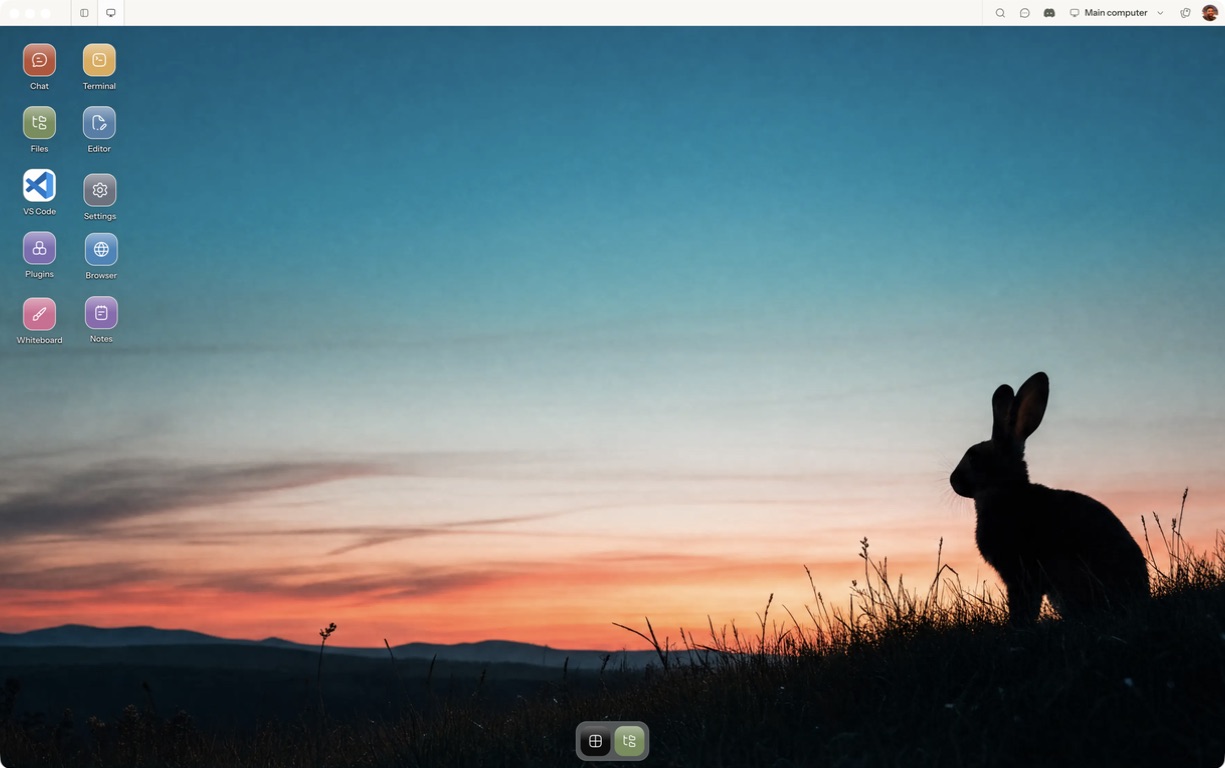
- Follow the quickstart to sign in, choose a computer and complete any required provisioning. To use the native app, follow the desktop installation and approval steps.
- Open a separate session with a small sample project or synthetic input. Configure the agent access needed for that task and make the expected output explicit.
- Validate the exercise first, then confirm identity, accessibility and cohort operations for a pilot.
Start with this small prototype, then discuss a scoped pilot for organizational access, integrations or governance. A workflow example does not imply that every proposed team capability is available in the product today.
Open Matrix →Read the quickstart →Current plans and pricing →